Geometry Rift: Apocalypse is a neon arcade roguelite with a free demo on Steam during Next Fest — and it’s made by a father and son in Spain. KongMNG Game Wire sat down (via email) with Víctor and Álex Vergara of Dad & Son Games to talk about growing a minigame into a full release, why local co-op matters, and what it’s really like making games with your kid.
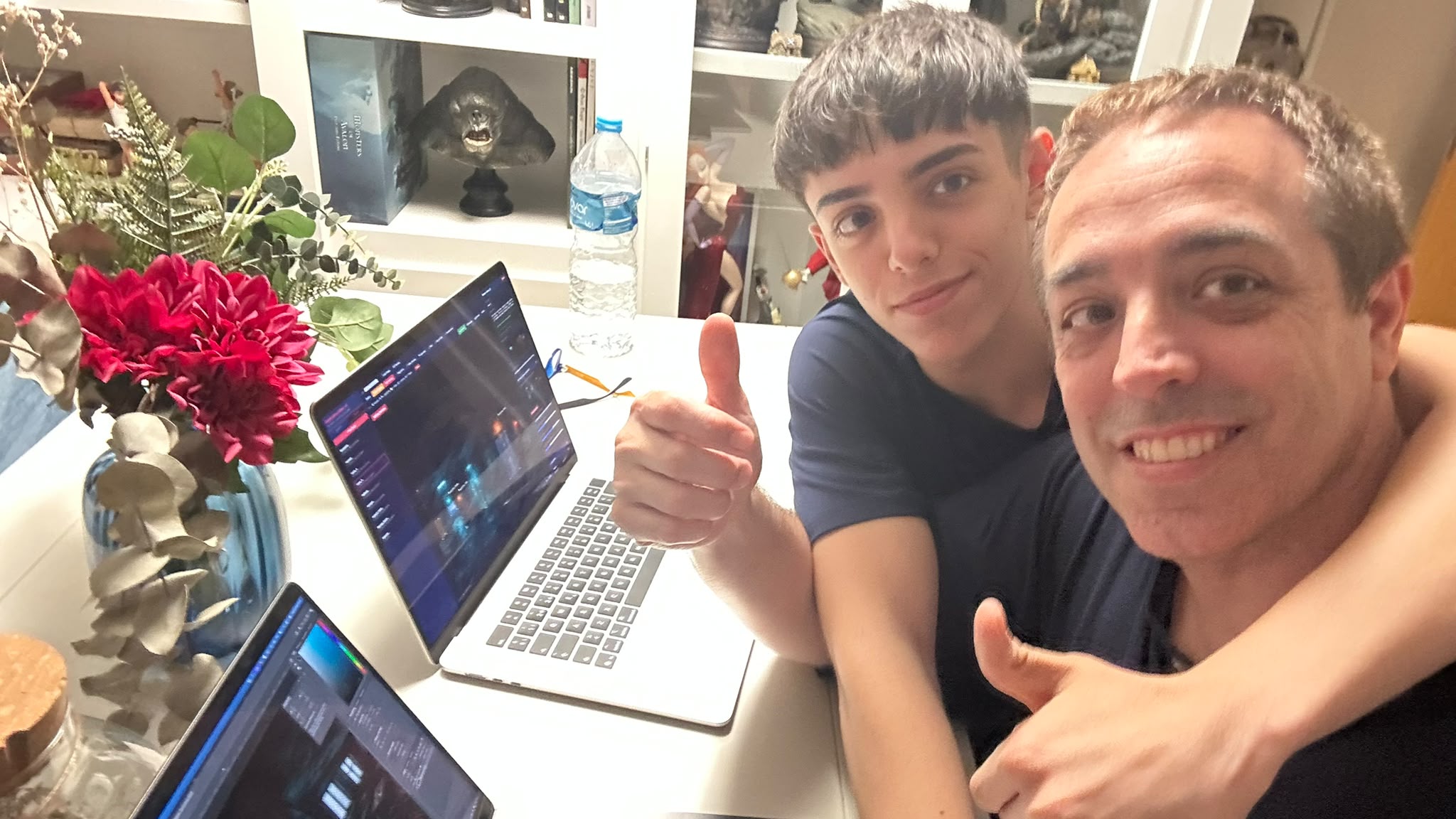
How did Dad & Son Games start? Was there a moment where you both decided “we’re making a game together”?
Víctor: Our first game together happened while we were on holiday at a campsite, of all places! There was a competition on Game Jolt, Álex was learning GameMaker, and we decided to make a little spaceship game. I did the graphics and music, and we had a pretty intense little development marathon together.
We didn’t win anything, but some people told us they really liked the idea of us working together and thought it deserved to do better. That meant a lot to us. It was something we had made together, and people we didn’t know had enjoyed it.
After that, we kept trying things. We spent about two years working on The Wall, a visual novel based on a short story I wrote when I was younger. Later, we developed a bunker survival prototype for a Game Jolt and Neowiz narrative jam, using a story by Álex. That one won first place, which was a huge boost.
Álex: We didn’t start with a business plan. We liked games, had ideas, and wanted to see if we could make something ourselves. Getting people to actually play it made it feel much more real.
Geometry Rift began as a small minigame inside another project. At what point did you realize it deserved to become a full game?
Víctor: Still Breathing (formerly The Bunker) had a vintage computer terminal with little minigames inside it. One day I made a prototype inspired by Geometry Wars, and it looked so cool that it became the starting point for Geometry Rift.
It wasn’t one dramatic moment. We kept adding things and finding more we wanted to do with it. Eventually, calling it a “minigame” became a bit ridiculous! We started that prototype around January or February, and it has grown into the project we’re now finishing.
Álex: A fun prototype doesn’t automatically mean you have a full game. It needs reasons to keep playing. The weapon combinations, progression and different challenges were what gave us room to build something bigger.
How do you two split the work? Who handles what, and has that changed as Álex has gotten older?
Víctor: Originally, I thought Álex would become the programmer and I would handle the graphics and music. That was my perfect plan, because programming was the part I enjoyed least. Unfortunately, I forgot to ask whether that was his perfect plan too! 😂
He tried different engines, but programming didn’t really interest him. What he enjoyed was writing stories, creating characters, designing gameplay and testing things.
So that’s how we work now. Álex handles narrative, game design, gameplay ideas and testing, while I handle programming, graphics, music and the technical side. I already had a programming background, and AI tools have helped me learn more and speed up parts of the work. Álex is also still studying, so we work around that.
Álex: I’m much more interested in what happens when someone plays. Does a mechanic make sense? Is it actually fun? Is there a reason to choose one upgrade over another? I’ll happily spend time picking those things apart. I also love working on this with my dad — he made me love videogames since I can remember, and we’ve played dozens of games together. Doing this now is kinda cool.
The pitch is Geometry Wars meets Vampire Survivors — two very different games. What did you take from each, and what did you deliberately leave behind?
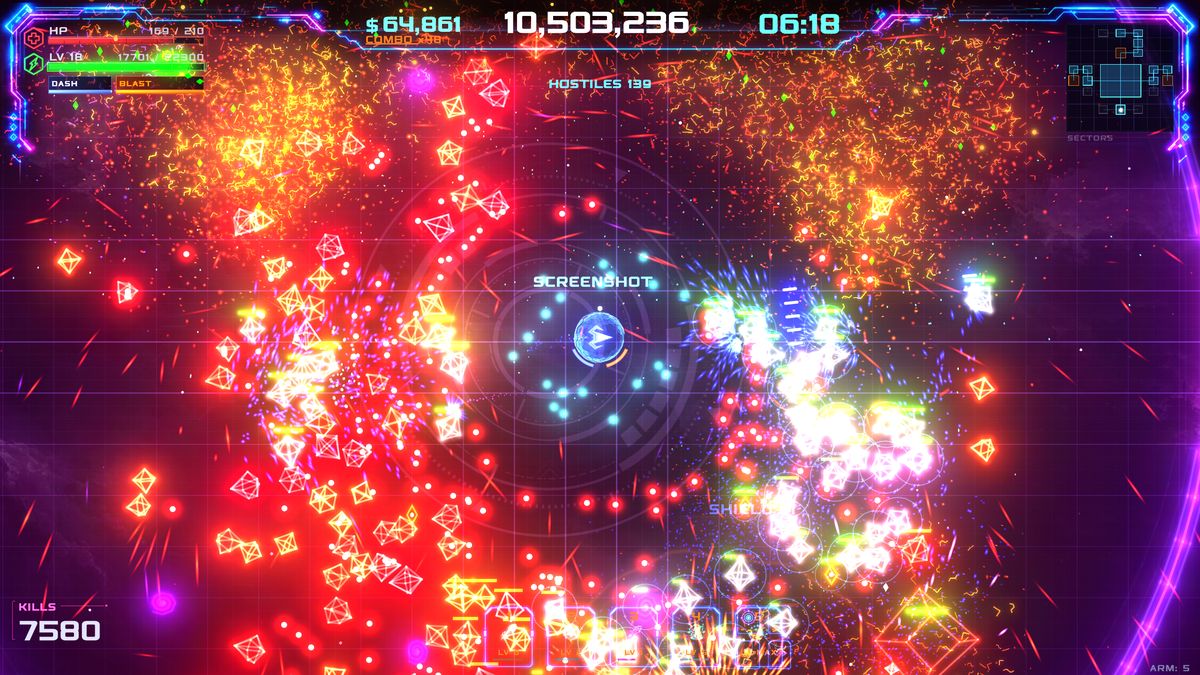
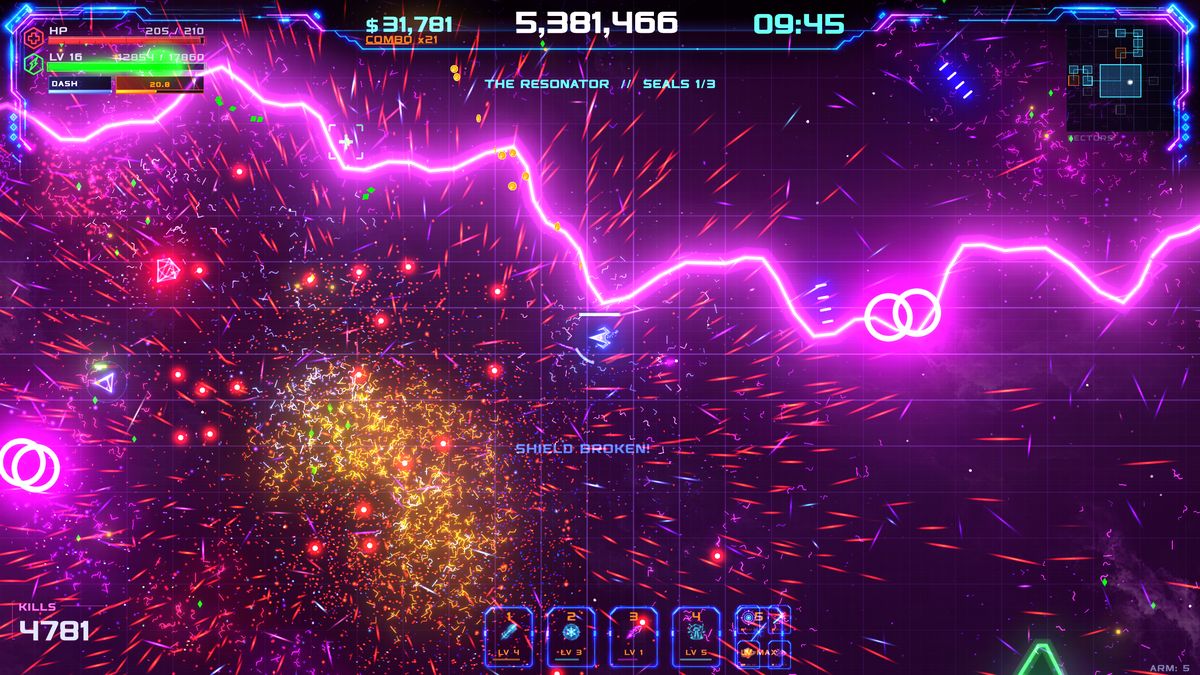
Víctor: Geometry Wars is the starting point for the arcade feeling and the visuals: moving through danger, geometric enemies, neon everywhere, and that wonderful chaos when the screen gets busy.
The Vampire Survivors side is about building up your weapons and discovering combinations that change how a run feels. We wanted that excitement of thinking, “Okay, what happens if I combine this with that?”
But we also wanted different objectives, bosses and ways to play, rather than every run being exactly the same kind of survival challenge.
Álex: My father started just cloning the game he loved from… 20 years ago? I didn’t play Geometry Wars, but I have played many roguelites and understand them better, so I told him to add lots of mechanics that made the game what it is now. A friend also told us about adding retro-inspired game challenges and we loved that.
Víctor: Yes, and that’s when I finally could add more to the game design, since I knew many games from those days and it was fun thinking about how to mix them with this game.
You offer both auto-fire and manual twin-stick aiming. Why was giving players that choice important instead of picking one?
Víctor: Because people enjoy different parts of these games. Some want to concentrate on movement, dodging and their build. Others really want to aim for themselves. Given the games that inspired us, it made sense to leave room for both.
Álex: I don’t think making everyone use the same controls automatically makes the game better. The important thing is that both options feel good and that the challenge still works. That’s something player feedback can really help us judge.
Víctor: Well that and… this: the game was auto-aim in the beginning, but I was tired of not being able to shoot at the boss in the first coding attempts. So I added a manual aim just for me… and then, I loved it so much I couldn’t go back to auto-aim… but then I remembered most people enjoy auto-aim, so… why not? And I just left both controller modes.
Two-player local co-op in 2026 is a bold choice. What made you commit to it?
Víctor: Honestly, this is probably the easiest question! Playing together has always been a big part of our relationship. We’ve spent so many hours finishing games, finding secrets and trying again after a terrible run.
We completed Enter the Gungeon together (100%), played The Binding of Isaac (100%), The Forest and plenty of others. Those are memories we share, and I want other people to have that with our games.
Whenever we can, we want to include local co-op. I love the thought of another father and son sitting together and saying, “Come on, one more try.”
Álex: And it doesn’t have to be a parent and child. Playing beside someone changes the experience. You can see their reaction, argue about what went wrong, or laugh when you both mess up. We like that. Some of my best memories from my childhood have been playing together. The moment we found the bunker in The Forest. The secret ending in Enter the Gungeon… the full story behind Isaac… or one of our most special memories, the ending of Sky — that’s one of my most beautiful memories of us playing together. One night, on a summer vacation, at night, in my grandpa’s house, we were together under a soft blanket playing with our two iPads online… and then we reached the end, a wonderful ending if you have played it, and we then had tears in our eyes. We looked at each other and… I don’t know. It was a beautiful moment.
Víctor: Yes, I also remember it as a very special touching moment. And that’s why we want to contribute to the gaming world with more co-op games. They’re great!
Víctor, you compose the soundtrack under your demoscene alias “Awesome.” How does that background shape the game’s sound?
Víctor: I’ve been making music on computers since I was about sixteen. In the demoscene I used the name Awesome, and I entered and won quite a few music competitions. That was a huge part of my life.
Making something that someone would listen to and remember was exciting then, and it still is now. I don’t want the music to be something you barely notice behind the game. I want it to contribute to the excitement, to make a moment feel bigger.
One of the nicest surprises has been hearing players talk about the soundtrack — and even the music player! When someone takes the time to tell me they love the music, that means a lot. That part of me hasn’t changed since those early days.
About the game, well, I wanted it to sound like a mix of synthwave and arcade games, so I took some unfinished tracks from the 90s, added some parts in Logic, and then used some AI tools to make variations of it, but using my own style and arrangements. That helped me do more tracks than just by myself, so the game has a lot of music variety, which makes it really much more fun to play. Music has been too important for me all of my life, so I need to make the best of the music for our games. It must stand out. And from the comments, I think I achieved it.
For both of you: what’s the most you’ve disagreed on during development — and who won?
Víctor: The biggest adjustment was probably my idea that Álex should be the programmer. I had this picture of how we would work together, but it wasn’t what he enjoyed. We had to find the roles that actually suited us.
With the game itself, I’m usually the more enthusiastic one. I’ll be excited about something we’ve added, and Álex will immediately find three things that still need work!
Álex: Something can be better than it was yesterday and still not be good enough. That’s usually my point.
Víctor: See? 😂 But it’s useful. I want people to feel that we’ve really cared about what we’re making, and that means somebody has to keep asking the awkward questions. At the beginning I was a bit annoyed when he started a sentence with “Dad, that new thing doesn’t work”… or “I don’t like that, it’s too ugly.” I used to take it badly, but later I saw he was always right and I didn’t see it. He’s the best at telling me what doesn’t work as he pictured it.
Álex: As for who won the programming argument… I’m not the programmer, hehe. :D
The Next Fest demo is live now. What kind of feedback are you hoping to get from players before the 2027 launch?
Víctor: Honest feedback. We’re thrilled when people say they’re enjoying it, but we also need to hear where they got confused, where something felt unfair, or where the fun dropped off.
The game is practically finished, but we’re still working on balance and checking everything as we move from Godot to Unity. We’re aiming for the first quarter of 2027, and we want to use this time well.
Álex: Difficulty is a big one. Someone experienced with these games might find a combination that makes things too easy, while a new player might get stuck before they understand their options.
I’d like to know which weapons people actually choose, which ones they ignore, and why. Also, if you stop playing, what made you stop? That can be more useful than just saying the game is good.
Víctor: Some people are already spending hours replaying the demo. For such a small team, seeing that is incredible. Now we need to listen carefully to what those players are telling us. The game has improved a lot after the reviews of the first players. It was really, really valuable!
What would you say to other parents and kids who want to make a game together but don’t know where to start?
Víctor: Start with something tiny. A little spaceship game at a campsite counts! You don’t need to begin with the huge game you’ve been imagining for years.
And don’t decide in advance what your child is supposed to be good at. I made that mistake. Let them find the part they enjoy, and build from there. I almost screwed everything up trying to force him into learning something he didn’t love. Fortunately I managed to see what he was good at, and I was able to do the rest, so we found the way to make this together.
For me, making games with Álex is already something special. Of course we want the games to succeed, but getting to create things with my son is a big part of why I’m doing this.
Álex: Make something you can finish, let people try it, and listen. Your first idea probably won’t work exactly as you imagined. That’s normal. Also, you should be able to tell each other when something isn’t fun. Even if your dad has just spent ages making it look really cool.
Víctor: Especially then, apparently. 😂
KongMNG’s take
The game looks great — neon chaos with real depth behind it. But the real story here isn’t the roguelite, it’s the two people making it. A dad who wanted his son to be the programmer and learned to let him be the designer instead. A kid who cried with his father at the end of Sky and now helps decide what’s fun. “Come on, one more try” isn’t just a co-op tagline for these two — it’s how they got here. The demo’s free on Steam — and it’s staying up even after Next Fest ends on October 26. Go try it, then tell them what you think. They’ll actually listen.